




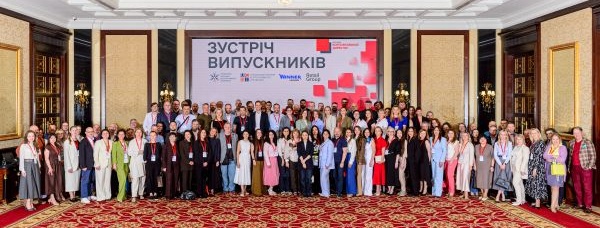
The Corporate Governance Professional Association held its traditional meeting of alumni from the ‘Corporate Director’ Professional Development Program for board members.
This year, the event brought together over 150 participants from various cohorts – members of supervisory and advisory boards, business owners, senior managers, company secretaries, and representatives from the public sector, financial institutions, and the legal, audit, consultancy and investment sectors.
The ‘Corporate Director’ alumni meeting is no longer merely the closing event of the latest program. It is a space for a professional community that, year on year, is growing, strengthening and shaping a new culture of corporate governance in Ukraine.
For many years, the ‘Corporate Director’ program has been bringing together people who serve on boards, are preparing for the role of corporate directors, or are responsible for strategic development, transparency, oversight, sustainability and the quality of governance within companies. That is precisely why the alumni reunion has become an important platform for exchanging experiences, professional networking and discussing the challenges currently facing corporate directors in Ukraine.
The highlight of the event was a panel discussion on ‘Career Development for Corporate Directors’. The discussion was moderated by Oleksandr Okuniev, Chair of the Board of Directors of CGPA.
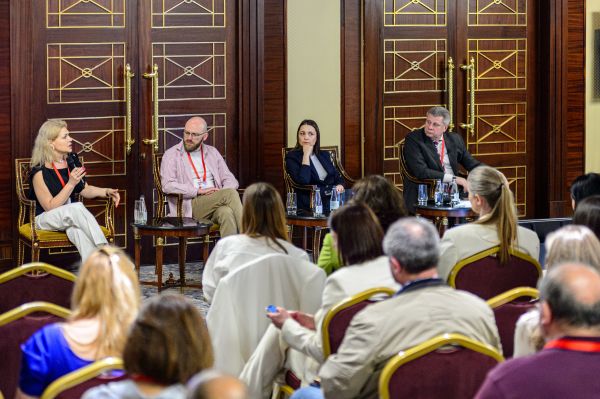
The panellists were:
- Anna Artemenko, Deputy Minister of Economy, Environment and Agriculture of Ukraine / board member — shareholder representative of the Joint-Stock Company ‘Naftogaz of Ukraine’;
- Andriy Yefimov, Head of the Department for the Control of Financial Transactions of Strategic Assets at the TAS Group, member of the Supervisory Board of TASCOMBANK and of the insurance and leasing companies of the TAS Group, and independent member of the Supervisory Board of the Municipal Enterprise ‘Mykolaivvodokanal’;
- Nadiia Vasylieva, member of the Board of JSC ‘Prozorro.Sales’ from 2019 to 2025, member of the Supervisory Board of JSC ‘Credit Agricole Bank’, and Chair of the Finance Committee of the Management Board of the International Charitable Organisation ‘Eastern Europe Foundation’.
The panel discussion focused on how a corporate director’s career path is shaped today, the competencies required to serve on boards, how to secure initial appointments, build a reputation, work with owners and management, and remain effective in conditions of high uncertainty.
Anna Artemenko spoke about the public sector and emphasised that corporate governance reform is impossible without people – strong professionals who understand their fiduciary duties, the principles of good governance and the role of the supervisory board as an institution. According to her, rules, the legislative framework and government policy are important, but it is the professionalism of board members that determines whether the reform will work in practice.
Particular attention was paid to the need for systematic onboarding of members of supervisory boards at state-owned companies. New board members, particularly foreign independent directors, must understand Ukrainian legislation, the specific features of the public sector, financial plans, the owner’s letter of expectations, and practical tools for working with state-owned companies. At the same time, government representatives must enhance their knowledge of corporate governance in order to effectively fulfil their roles as shareholders and board members.
The discussion also covered the challenges of the nomination process, the need for better preparation of candidates for service on supervisory boards, the importance of reputation, diversity within boards, and issues of gender balance. It was emphasised that professionalism must remain the fundamental criterion, but diversity – in terms of experience, age, skills, international background and gender – makes boards stronger.
Anna Artemenko also noted that the demand for professional board members will grow not only in the public sector but also at the level of municipal enterprises. This opens up new opportunities for the career development of corporate directors, but at the same time requires systematic training, clear procedures, high-quality onboarding and the ability of the owner to work with boards in accordance with modern standards.
Andriy Yefimov shared his experience of transitioning from the role of shareholder representative in a large private group to that of an independent member of the supervisory board of a municipal utility. His involvement on the Supervisory Board of the Municipal Enterprise ‘Mykolaivvodokanal’ served as an example of how a corporate director can broaden their professional trajectory by working across different sectors – private, financial and municipal.
He emphasised that the role of an independent director is not voluntary work, but a professional responsibility. Such experience provides an opportunity to view interactions with the owner, management, other board members and the community in a different light. Experience in the public utilities sector is particularly valuable, as corporate governance is still taking shape there and the challenges are very specific: ranging from the quality of management and staff shortages to communication with the community and residents’ understanding of the supervisory board’s role. Participants noted that corporate governance reform in municipal enterprises is complex but irreversible. It requires time, explanation to local authorities and the community, professional communication, well-drafted contracts and a willingness on the part of board members to work under conditions of high accountability.
The role of international experience in the work of boards was a separate topic of discussion. Andriy Yefimov emphasised that interaction with board members who have experience of corporate governance in other countries and sectors is an important source of professional development for the entire board. This provides a clearer understanding of the roles of the owner, management, independent directors and the board itself as a collegial body.
Nadiia Vasylieva spoke about the future of board work in the context of the development of artificial intelligence. Participants discussed whether digital tools could replace physical boards and concluded that it is currently too early to talk about a fully AI-based board. Artificial intelligence can be an important tool to support the board’s work, but it does not replace human experience, accountability, values and the ability to deal with uncertainty.
n this context, Nadiya Vasilyeva outlined the concept of an ‘augmented board’ – a board that uses digital tools for preparation, document analysis, data management and more efficient use of time. This allows board members to spend less time on the technical processing of materials and more on what is at the heart of a corporate director’s role: asking the right questions, identifying strategic risks, engaging in discussions with management and making responsible decisions.
During the discussion, participants also spoke about the barriers to career development for corporate directors: the requirement for certain categories of board members to declare their interests, the complexity of contractual procedures, the need for directors’ liability insurance, a shortage of qualified candidates, the insufficient number of Ukrainian candidates on shortlists for independent director positions, and the need to establish a well-defined market for professional board members.
For CGPA, such a meeting is a vital part of developing the professional community. After all, effective corporate governance is impossible without people who possess not only knowledge, but also values, experience, a good reputation and a willingness to take responsibility for the quality of management decisions.
Having over 150 graduates gathered in a single hall is the best confirmation that a strong community of corporate directors is taking shape in Ukraine. These are people who are working to develop boards, increase transparency, strengthen trust in business and state-owned companies, implement best practices in corporate governance and create more resilient organisations.
The event concluded with an informal get-together and networking session, which gave participants the opportunity to continue their discussions, share experiences, make new professional contacts and stay in touch with alumni from different years of the program.

Щиро дякуємо всім учасникам зустрічі, спікерам панельної дискусії та випускникам програми «Корпоративний директор» за активність, довіру і внесок у розвиток професійної спільноти корпоративного управління в Україні.