




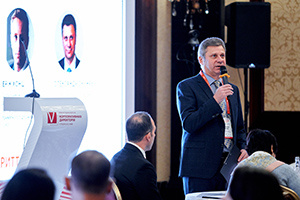
 On December 7, 2021, the Fifth International Corporate Directors Forum (Forum) was held. The Forum was organized by the Corporate Governance Professional Association (CGPA), the Ukrainian Corporate Governance Institute, in partnership with the Centre for International Private Entrepreneurship (CIPE) with the support of the International Finance Corporation (IFC) in partnership with the Swiss State Secretariat for Economic Affairs (SECO).
Oleksandr Okuniev, Chairman of the CGPA Management Board, greeted the participants and wished them fruitful and interesting discussions. He also thanked the partners of the event for their support. This year, about 30 companies, institutes, and organizations joined the International Corporate Directors Forum preparation.
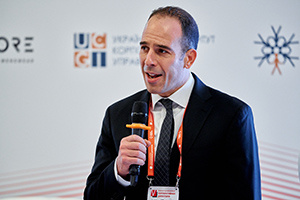 Welcoming the Forum participants, Jason Pellmar, IFC Regional Manager in Belarus, Moldova, and Ukraine, emphasized that the Forum became the place to discuss the new challenges facing the companies. “No one argues that ESG is crucial for investors in making their financial decisions, but it’s no longer only about attracting investors. ESG is all about good business practice and risks mitigation that can ultimately increase profitability and investment valuation,” – J. Pellmar said. He continued: “We are talking about sustainable development, success, transparency, risk management, emphasizing that the principles of corporate governance are very important for both private and state companies. The company’s supervisory boards should include directors who will work to develop Ukrainian companies and increase private and public capital“.
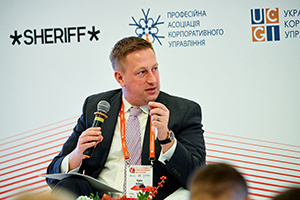 Eric Hontz, Deputy Regional Director for Europe and Eurasia, stressed that CIPE is a partner of the International Corporate Directors Forum for the fifth time in a row. CIPE is convinced that the Forum promotes developments of good corporate governance in Ukraine as an open discussion platform.
Corporate social responsibility is an integral part of the development of a modern corporation. By investing in ESG, you are investing in the company’s reputation. Leaders of Ukrainian companies Nova Poshta, Astarta, and experts in the field of corporate governance spoke about this at the Forum during the first session on ESG and Business Ethics.
“ESG is a fundamental issue for the corporation,” Eric Hontz said. – “Systematization of ESG is an investment. It will take some time, and we will be able to see the business’s profits, the company’s high reputation, and its high level in the market. It’s easy to play dirty and earn fast. But playing by the rules is a game for the long run, development and raising capital. “
Today, companies are trying to develop social responsibility. Their experience shows that it is very profitable.
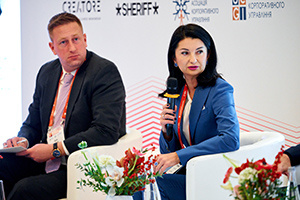 “We are actively developing the direction of social responsibility. Assistance to hospitals in the fight against COVID-19, free delivery of goods for the army, opening an administrative hub for the villagers in Luhansk region, support of the running movement – this is far from a complete list of what Nova Poshta as a responsible corporate citizen does for the country,” Iryna Papusha said, Chairman of Nova Poshta’s Supervisory Board. Vyacheslav Klimov, Co-founder and Member of the Nova Poshta Supervisory Board added that the projects are already yielding results and working effectively for the company’s reputation.
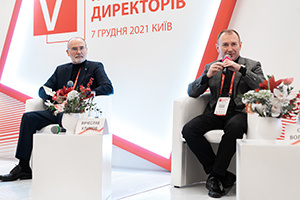 V.Klimov is against the pressure on business from international institutions. “The DNA of any business looking for success is finding its approach to sustainable growth, the essence of which changes over time. It used to be more of a business conversation; now, everything is changing. Businesses should and can do this by their choosing to attract new consumers, investors and partners, ” V. Klimov stressed.
Viktor Ivanchyk, the Founder and CEO of Astarta, estimated that his company has already invested a total of $ 23 million in ESG. “Our goal is to develop local communities, develop local business and entrepreneurship, especially women’s entrepreneurship in small communities.“
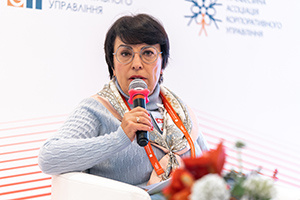 Olena Voloshyna, Head of the IFC’s Operations in Ukraine, said that international companies are reluctant to fund projects of the companies not working on creating the corporate ESG. O. Voloshyna also noted that today the needs of stakeholders should be taken into account in the first place, especially the younger generation, which pay great attention to the company in which they work.
Today, the presence of quality corporate governance in companies is one of the prerequisites for attracting investors to specific businesses, ultimately – in the Ukrainian economy. Hence, the supervisory boards face many ambitious tasks. This conclusion was reached by the participants of the session “Corporate Governance and Financing Attraction: Current Challenges for Supervisory Boards.”
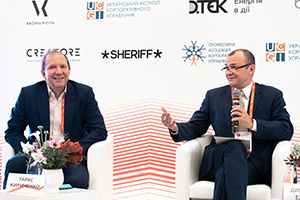 “We need to remember that corporate governance allows companies to access capital markets and finance that cannot be obtained from private sources,” Dimitry Elkin said, co-founder and managing partner of Twelve Seas Capital. He drew the attention of the forum participants to the prospects of using SPAC, which is gaining popularity on the stock exchanges of the United States and Europe. “Currently, there are 500 SPAC funds with capital, which are looking for companies to invest. And for Ukrainian businesses, this is a great opportunity: the first-ever SPAC was created just for a Ukrainian company, and although it didn’t work out then, interest remains for Ukraine,” – Dimitry Elkin said.
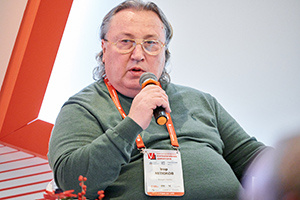 Igor Mitiukov, former Head of Morgan Stanley in Ukraine, confirmed that SPAC gives companies a chance to gain quick access to investment. “It is enough for a company to have a convincing business plan and think about the future, rather than show three-year reporting and transparent corporate governance, so the period for reaching the international level is reduced to a few months,” he said.
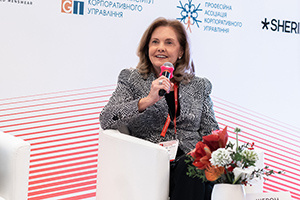 State-owned companies, and banks, in particular, have slightly more obstacles in this way. According to Sharon Easky, Chairman of the Supervisory Board of PrivatBank, boards in such companies must make sure that all processes within the company are well-established and efficient and have confidence that this situation will continue after the change of ownership. The advantage of PrivatBank, in this case, is the international composition of the supervisory board when specialists with different backgrounds and experience have to find compromise solutions.
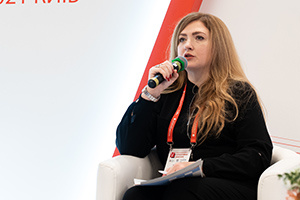 “The presence of effective corporate governance is an additional guarantee for the investor of investment reliability,” Olena Korobkova, Chairwoman of the Board of the Independent Association of Banks of Ukraine, said. – It’s like an IMF tranche: when a country receives it, it works as a benchmark, as an indicator of confidence in the country, and then other financial institutions come. That’s why corporate governance is our future.”
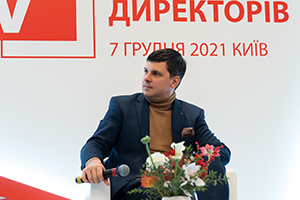 “Aurora’s case is finally a good case!” – Volodymyr Ihonin, Head of Corporate Law / Mergers and Acquisitions, Vasil Kisil & Partners, opened the session “Participation of the Board in the process of attracting investors.” According to him, corporate governance in the infospace of Ukraine is a bit unpopular because there is little good news that would show that this is a good and necessary thing. Hence, the experience of “Aurora” is significant as a motivational example.
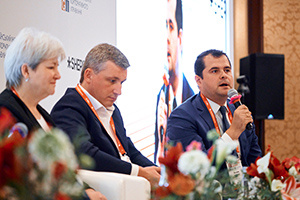 As Vasile Tofan, senior partner and member of the Horizon Capital investment committee, explained, the following things are essential for private equity: a promising market and company management that shares our values, such as honesty, reputation, competence, presence of real competitive advantage, business transparency and high-quality corporate governance, as well as the possibility to exit the investment. Aurora had all of these elements, so the deal went through.
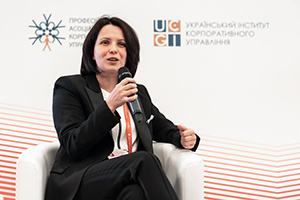 Aurora shareholders Taras Panasenko and Lesya Klymenko talked about the history of the decision to involve the board and the positive things they got out of it.
“If you want to look at yourself from the side – invite the board; if you want to evaluate – try to attract private equity. You will learn a lot about yourself,” Lesya said but warned that you should not be afraid when you are asked an awkward question or a question to which you do not have an answer. “It strengthens and improves your business,” she said.
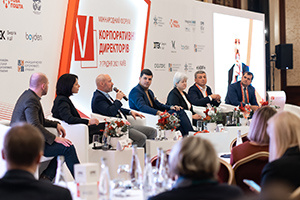 Igor Gut, a member of the Board of Aurora, supported the thesis of readiness to have unpleasant talks and complex negotiations. “My role was at the beginning – to explain to the investor the business model, what is the uniqueness of the system, as well as to predict the future. Horizon was very skeptical of our optimism, and we had to convince ourselves three times that we had grounds for it.“
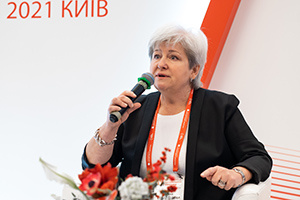
At the same time, according to Iryna Starodubova, a member of the Aurora’s Board, attracting an investor was not a goal in the case of Aurora. Still, a means to achieve the goal set by the company. “But since the owners usually attract an investor to the company once in a lifetime, this is always an unusual event that is a little scary. I have experienced about 20 M&A deals, and I benefited the most from the negotiations. And it was a great case, ” she shared.
“Bord must understand that he is building something that could be sold to the next generation, which is in 25 years. It is important to get a win-win for yourself and the investor and to build a platform that will generate money for the company,” Oleg Drin said.
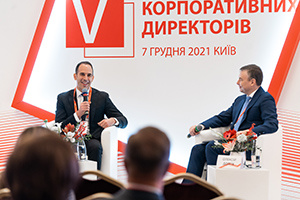 “The new members of the supervisory boards of state-owned enterprises, whom we will elect after the termination of the current boards, must work better than their predecessors and cooperate better than their predecessors. All the failures in recent years result from an unwillingness to work together within the board or an inability to reach an agreement between the supervisory board and the management board. We will pay attention to such compatibility as early as the selection process on the committee” – Jason Pellmar, Chairman of the Nomination Committee, shared plans for the near future in an interview by Alexei Dolgikh, Managing Partner of Boyden Ukraine.
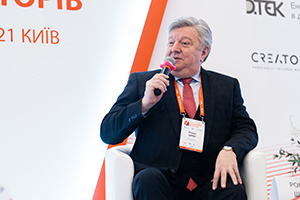 “We are not looking for stars; we are organizing constellations,” Roman Shpek, Chairman of the Supervisory Board of Alfa-Bank, aptly formulated the answer to the key question of the session “The Role of the Chairman of the Board: Best Practices.”
According to other participants in the discussion, Volodymyr Zhmak, Chairman of the Supervisory Board of Boryspil Airport, and Vladyslav Burda, Founder, and CEO of RedHead Family Corporation, depending on whether the company is state-owned or a family business, the tasks of the Supervisory Board, are somewhat more complicated.
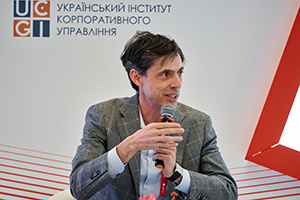 “The chairman of the board must determine who is the main customer in the company. In the family business, this is even more difficult than in state-owned companies or corporations – it is necessary to clearly understand who is the center of decision-making and the main protagonist. And this is not always the business owner and not even his mother,” Vladislav Burda shared his experience.
However, all speakers agree on one thing: the main task of the chairman of the supervisory board is to keep the board in a state of engagement, i.e., to keep his attention on the company’s activities without interfering in operational management, unless circumstances require.
A survey of Forum participants found that almost 60% were concerned about inviting stars (celebrities) to supervisory boards, and the same 60% suspected that this trend would continue in the future.
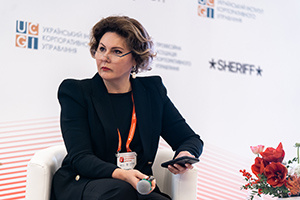 Natalia Kryvda, Academic Director of Edinburgh Business School in Ukraine, Oleh Makarov, People’s Deputy of Ukraine, Svyatoslav Vakarchuk, Member of the Board of Directors of Kyiv School of Economics, Olga Bogomolets, owner and chief doctor of the Dr. Bogomolets Institute of Dermatocosmetology, and Alexei Volynets, IFC Corporate Governance Officer, talked about the “stars/celebrities” in the bords.
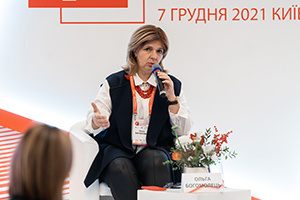 “Being a ‘wedding general’ is a dubious honor,” Olga Bogomolets said. – A member of the supervisory board must clearly understand five things: the goal (his and the company’s), the tools to achieve it, the possibility of control, the benefits (his and the company’s), and the consequences. If one of these elements is missing, you should not risk your reputation, even for financial reward or temporary benefits of holding a position.
Moreover, according to Oleg Makarov, “it is not enough to know your worth; you have to be in demand.” “We need to see who invites you. If decent companies and decent people don’t want you, maybe you should return to your core business,” he said.
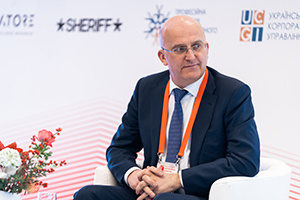 But if a company’s reputation and goals meet the interests of the guest star, their presence can be a real benefit, not just in nonprofits such as charitable foundations or social projects. “We must not forget that famous people are successful people. That is, they have unique experience and knowledge that can also be useful to the company,” – Alexei Volynets said. “The main thing is that there are enough professional managers on the supervisory board who are oriented in the specifics of the business and can really control the activities of management.”
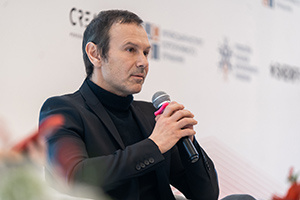 But even professional managers with an impeccable reputation can make mixed decisions together. “Then the question of whether you are ready to defend it and receive negativity or misunderstanding, or the purpose for which you work, is more important than the need to associate with people you do not like. If it is worth it, you can take a risk,” Svyatoslav Vakarchuk said.
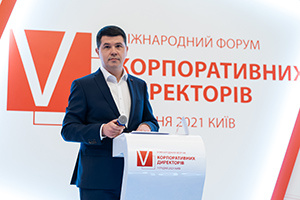 “We made the first assessment of the work of the supervisory board in 1996, and I would not like to repeat it,” Beverly Behan said, a leading global expert on the effectiveness of the boards, in an interview with Oleg Zhuravlov. – Do not repeat our path and our mistakes. Ukraine can immediately use good practices; you are very lucky“. Beverly described her best practices in Evaluating Boards and Directors: Innovating in Corporate Governance Committees in the 21st Century, highlighting eight parameters that need to be considered and evaluated to get a complete picture of how a supervisory board works.
 “Do not consider the assessment as another report, do not tick off, do not waste time. Treat it as a tool to improve your work,” she said, drawing on 20 years of experience in this field with nearly 200 companies worldwide.
General partner of the Forum: Nova Poshta
Official legal partner: Vasil Kisil & Partners
Official energy partner: DTEK
Official HR partner: Boyden Ukraine
CREATORE was a business style partner.
SHERIFF was a security partner.
PGR Consulting Group was a partner in strategic communications.
Jack Daniels was the sponsor of the cocktail party.
The Forum was organized with the support of UAIB, DYB, Edinburgh Business School, House of Knowledge, NDU, NABU, USUBC, EMCON, UNIC.
Media partners of the Forum – Yurydychna Gazeta, LIGA.net, RBC-Ukraine, Live TV channel.
Video in massmedia