




The situation in which Ukraine and its business find themselves forces entrepreneurs and directors to look for opportunities to survive, maintain production, find markets, etc. One of the most discussed measures is relocation – moving a business or its components to another, safer place.
On May 12, 2022, the Corporate Governance Professional Association (CGPA) organised the online conference “Business Relocation Abroad: Who, Why and How Can Help?” Participants discussed the following topics: when to think about relocation abroad, what factors should be considered, and who and how can help in these challenging projects. The CGPA organised the event with the support and participation of partners: Center for International Private Enterprise (CIPE), Business Ombudsman Council in Ukraine, Kinstellar Law Firm, and European Bank for Reconstruction and Development. The event was moderated by Oleksandr Okuniev, the CGPA Management Board chairman.

The following questions were discussed during the event:
- To relocate or to wait?
- What factors should be considered when choosing a relocation country (company size, industry, market, availability of resources, taxation, etc.)?
- Pros and cons, peculiarities of the countries of relocation (Poland, Romania, Hungary, Moldova, Slovakia, Canada)
- Local programs supporting the business relocation from Ukraine
- Who and how can help during the relocation of the Ukrainian business?
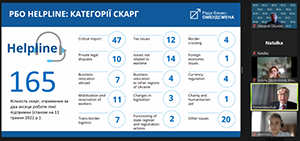
Roman Vaschuk, the Business Ombudsman in Ukraine, distinguished three incentives for business relocation abroad. The first is crisis circumstances when the business can not continue its production activities for one reason or another and requires finding another location to continue operating. The second is creating a corporate legal entity in a more stable jurisdiction, against which one can try to collect credit. The third is the prospect of Ukraine’s candidate status or EU membership. It is opening an office or moving part of the business to a European country that will facilitate harmonious and easier integration into the business environment and market of the European Union.

Halyna Zahorodniuk, the partner of the Kinstellar Law Firm, noted that if Ukrainian business people have ever thought of moving, enlarging or expanding their business in Europe, there is no better time than now. It should be remembered that every crisis is an opportunity for growth and development. These opportunities should be used. It is desirable to do it right from the beginning, taking into account all the legal rules and regulations of the new country. One of the best solutions for the relocation of Ukrainian business, especially regarding the transfer or creation of production facilities, is the EU industrial parks. The network is quite extensive in Poland, Romania, Moldova, and Slovakia with the existing developed infrastructure.

In his presentation, Andriy Kornuta, a lawyer at the Kinstellar Law Firm, focused on the legal nuances of relocation of businesses, especially manufacturing companies, in European countries neighbouring Ukraine. In particular, the features of full and partial relocation of business or production facilities were highlighted. Brief information developed by Kinstellar specialists was also presented, where the most necessary information for entrepreneurs considering opening, relocating or expanding their business to Poland, Romania, Slovakia, Hungary and Moldova, was clearly explained.

Veronica Arpintin, Manager of EBRD Small Business Advisory Program in Moldova, drew participants’ attention to the fact that rules for Ukrainian producers in the EU markets are generally the same as for all others – with strict requirements for ecology, quality standards, compliance, as well as payment of taxes and duties. Moldova and some EU countries are working on simplifying some procedures for Ukrainian enterprises, such as the online opening of bank accounts, business registration, etc. However, by giving access to its market, the EU and other countries do not create warm conditions. One should be prepared for competition, market specifics, and linguistic and cultural differences. Moldova signed a free trade agreement with the EU more than seven years ago and worked to harmonise legislation. Consequently, those companies, which had no experience in the EU markets, prefer the more comfortable and less expensive market of Moldova to use it as a trampoline to the EU—among the successful Ukrainian businesses opened in Moldova and Romania, Veronica mentioned restaurant business and services (engineering services, dry-cleaners, trade, and business consultants). There are both success and failure stories. In any case, it is necessary to rely on the experience of professionals (consultants) when entering new markets and remember the assistance the EBRD provides to Ukrainian businesses, as colleagues from EBRD Ukraine and in Moldova and other countries.
Relocation, movement or expansion of business abroad is the choice of every Ukrainian entrepreneur who wants to continue operations in times of crisis effectively, especially now in times of war. Every entrepreneur thinking of relocating or expanding his business should weigh and examine all possibilities, advantages and obstacles which could appear on the way to developing activity in the countries neighbouring Ukraine.
All materials of the conference are available on the website of the event : https://zahody.cgpa.com.ua/relocation/#b13726