




February 26–27, 2026, a two-day online workshop titled “Disclosure Requirements for Issuers in 2026” was held, organized by the Ukrainian Corporate Governance Institute (UCGI) and the Corporate Governance Professional Association (CGPA) with the support of partners – EMCON and ARIFRU. The event brought together over 100 participants from various sectors, including corporate secretaries, lawyers, and financial specialists from issuing companies.
The workshop program was packed with content, covering both the theoretical aspects of the legislation and practical recommendations. Participants reviewed NSSMC’s requirements for 2026, the procedure for issuers’ disclosure of information (composition, volume, and submission deadlines), the technical formats XML and iXBRL, and the capabilities of the software products “EMCON: Report” and SMIDA.
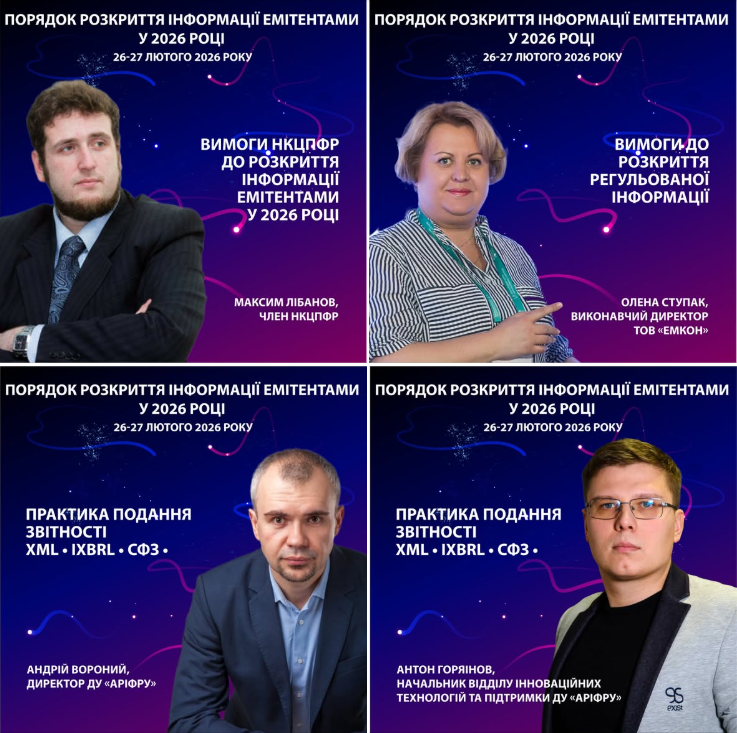
The keynote speakers were NSSMC member Maksym Libanov, Executive Director of EMKON LLC, Olena Stupak, as well as Director of the State Agency “ARIFRU,” Andriy Voronyi, and Head of the Department of Innovative Technologies and Support at the State Agency “ARIFRU,” Anton Goryainov.
In his speech, Maksym Libanov emphasized the importance of returning to standard operating procedures: “Throughout 2024, we operated under [martial law]. That is, the market was temporarily exempt from the obligation to disclose regulated information, with the exception of specific cases. However, this adaptation period has ended, and the obligation to disclose information has officially resumed.”
Maksym Libanov also highlighted the system of issuer liability: Article 50 of the Law sets the upper limit for penalties. At the same time, the imposition of a fine is not automatic. The Commission has alternative enforcement measures provided for in Article 49, and a financial penalty is imposed only when it is the most appropriate and proportionate measure. When determining the fine amount, the nature of the violation, its consequences, and the issuer’s financial condition are taken into account. In addition to his presentation, M. Libanov held a separate Q&A session, during which he addressed some of the complex questions regarding the NSSMC’s position submitted in advance by participants.
In her presentation, Olena Stupak focused on the NSSMC’s requirements for disclosing regulated information, as well as the specifics of publishing annual and interim reports for different categories of issuers. She then focused on common mistakes issuers make during the disclosure process, particularly regarding publication deadlines, completing forms correctly, posting information on the website, and complying with technical requirements for XML and iXBRL. She provided a detailed explanation of liability for untimely or incorrect disclosure, the procedure for correcting errors, and interaction with the NSSMC. Her presentation was followed by an active Q&A session, during which participants received specific recommendations on minimizing risks and practical action plans for non-standard situations.
Olena Stupak emphasized the importance of complying with the rules: “Disclosure is an area of heightened regulatory scrutiny and ongoing responsibility for issuers. Even without changes to the requirements, errors in deadlines, scope, or disclosure formats can have serious consequences.”
The technical aspects of the process and the benefits of automation were highlighted by ARIFRU representatives Andriy Voronyi and Anton Goryainov. The speakers systematically outlined the 2026 context for issuers, specifically the requirement to comply with XML and iXBRL standards when preparing reports. They presented 2025 statistics analyzing the most common errors in SFZ and XML files that result in reports having to be resubmitted.
Special emphasis was placed on pre-validation as a tool for reducing the risk of report rejection; process automation via APIs and the benefits of integration; new features of Smida Xml Reports; the specifics of submitting financial reports through the Central Financial Reporting System (CFR) during non-standard reporting periods; and the issue of dual signing (the auditor’s electronic digital signature).
Практичні рекомендації щодо мінімізації регуляторних ризиків стали одним із найбільш цінних елементів обговорення, адже дозволили учасникам отримати чіткі орієнтири для підготовки звітності у 2026 році.
Для тих, хто не зміг приєднатися до заходу або бажає детальніше вивчити всі роз’яснення, є можливість придбати запис практикуму. Для цього необхідно заповнити форму за посиланням https://forms.cgpa.com.ua/crm_form_43jiz/