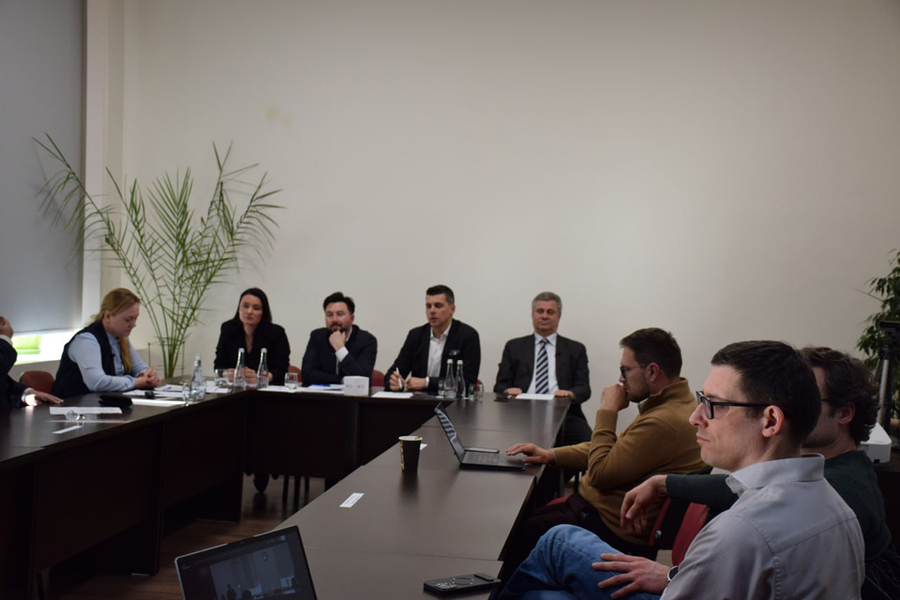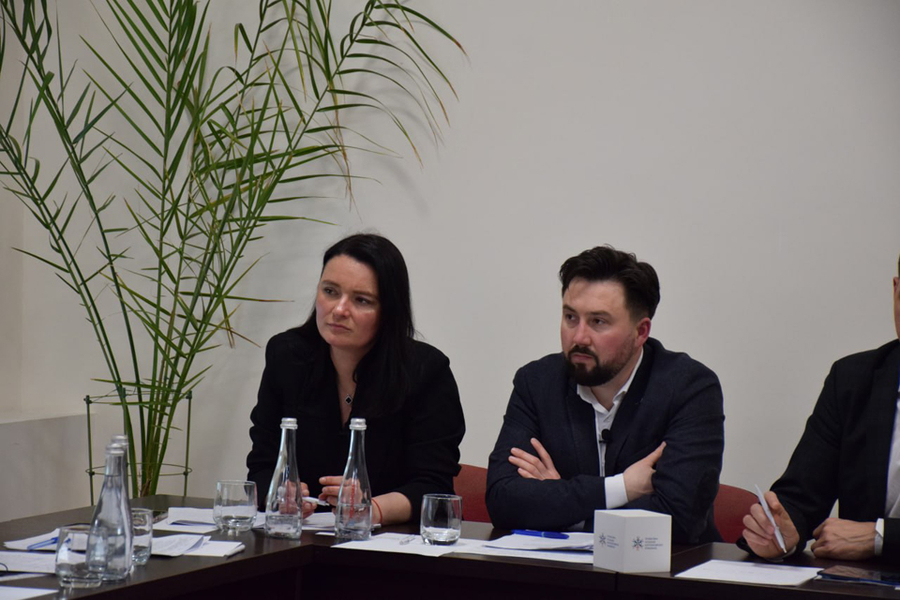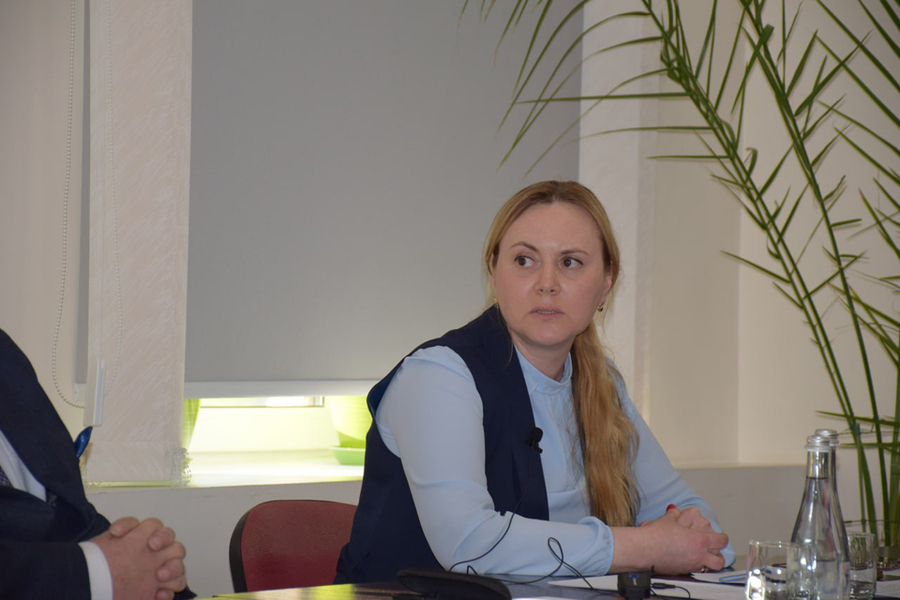
On 6 April 2026, a joint meeting of the Ukrainian Bar Association’s Committee on Corporate Law and the Stock Market and the Corporate Governance Professional Association was held in Kyiv, focusing on one of the most contentious issues in corporate law: the payment of dividends in companies with state ownership.
The event brought together representatives of government bodies, the judiciary, the business community, the legal profession and the academic community for a professional discussion of approaches to the formulation and implementation of dividend policies in such companies.
The event was moderated by Volodymyr Igonin, Deputy Chair of the UBA Committee on Corporate Law and the Stock Market, member of the Board of Directors of the Corporate Governance Professional Association, and partner at Vasil Kisil & Partners.
The event was attended by:
- Maksym Libanov, member of the National Securities and Stock Market Commission (NSSMC);
- Olesya Lukomska, Head of the Department of Analytical and Legal Work at the Commercial Court of Cassation within the Supreme Court;
- Oleksandr Okuniev, Chairman of the Board of Directors of the Corporate Governance Professional Association;
- Serhii Derkach, member of the Board of the Ukrainian Bar Association’s Committee on Corporate Law and the Stock Market, partner at ARIO Law Firm;
- Oleksandra Kologoyda, Doctor of Law, Professor at the Institute of Law of Taras Shevchenko National University of Kyiv.
During the event, participants focused on a comprehensive analysis of approaches to the payment of dividends in companies with state ownership, in particular on determining the procedure for their payment, the amount, and the role of management bodies in making the relevant decisions. Particular attention was paid to situations where a resolution of the general meeting on the distribution of profits is not adopted, yet the legislation provides for an obligation to pay a portion of net profit to the state budget.
Participants discussed the conflict between corporate law, which enshrines the exclusive competence of the general meeting regarding profit distribution, and budgetary regulations, which establish mandatory requirements for the payment of dividends. In this context, considerable attention was paid to the legal nature of such payments, their relationship to the traditional understanding of dividends, and the permissibility of making them without a corresponding resolution of the general meeting.
A separate part of the discussion concerned judicial practice, which currently remains inconsistent. Participants noted the existence of different approaches to resolving disputes, in particular regarding the possibility of applying the State Budget Law as a special act, as well as the need to observe the principle of equality of shareholders in such legal relationships.
The evolution of legislative regulation of this issue was also analysed — from the provisions of the law on the management of state-owned assets to the current practice of enshrining relevant provisions in state budget laws. Participants drew attention to the fact that such a regulatory model raises questions regarding its compliance with constitutional principles and the general principles of corporate law.
The event also examined international experience, in particular the approaches formulated by the OECD, which emphasise the need to ensure a balance between the state’s fiscal interests and the development needs of state-owned enterprises. It was noted that, under martial law, this dilemma takes on particular relevance, as the state requires stable budgetary revenues, whilst excessive profit extraction may negatively impact companies’ investment potential.
Following the discussion, the participants concluded that there is currently no uniform approach to law enforcement regarding the payment of dividends in companies with state ownership. This necessitates further improvement of legislative regulation, the development of consistent judicial practice, and the search for a balanced model that would take into account both the interests of the state and the rights of other shareholders.
The event confirmed the relevance of this topic and served as a platform for further professional dialogue on the development of corporate governance of state assets in Ukraine.
Based on materials from the APU