



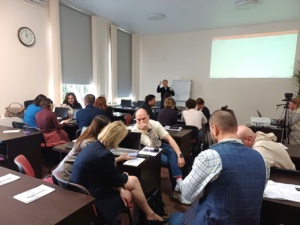
 16–17 April 2026, a strategic workshop was held for members of boards of directors and senior executive management of companies entitled ‘Innovation in Corporate Activities: The Role of the Board. The Board’s Use of AI”. The event focused on how boards of directors should approach artificial intelligence, not as a technological fad but as a matter of strategy, risk, accountability, and the quality of management decisions.
The program was structured first to lay the foundations: the role of the supervisory board in strategy and risk control, the boundaries between oversight, approval, and delegation, and only then move on to the practical application of AI. Participants explored topics including digital transformation, the board’s areas of oversight, operational risks associated with AI implementation, AI governance, and directors’ personal effectiveness, ranging from working with assistants to a deeper analysis of the board pack.
The program’s chief ideologist and speaker, Nadiya Vasilyeva, noted: “Despite the complex security context, the workshop took place as planned. It is precisely this reality that provided the crucial backdrop for the program’s central theme: today, board members must make decisions not in conditions of abstract comfort, but in conditions of high uncertainty, rapid change, and heightened responsibility””
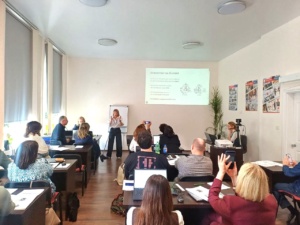 A key focus was the distinction between management and the board in the use of AI. For management, artificial intelligence is first and foremost about efficiency, speed, new processes, approaches, and sometimes even new products. For the board of directors, it is a tool for improving decision quality, exercising control, and shaping new business models that create value for owners, customers, and stakeholders.
As part of the program, participants analyzed real-world case studies, discussed the ethical and reputational implications of AI use, compiled a list of key questions for the CEO, CIO, and CFO, and developed their own scenarios for integrating AI tools into the board’s activities.
One of the practical takeaways from the workshop was the realization that the main challenge in scaling AI within companies lies not solely in the technology. Only around 20–25% of companies move AI solutions from the pilot phase to full-scale implementation. The main barrier is not access to tools, but the quality of governance, readiness for change, proper oversight, and a clear framework of accountability.
The workshop’s concluding framework was clear: the board does not directly manage AI – it manages the company’s ability to use AI responsibly, safely, and effectively. That is why the discussion on artificial intelligence for boards begins not with tools, but with strategy, risks, corporate governance, and the ability to ask management the right questions.
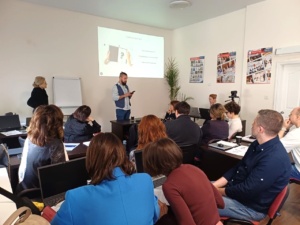 The composition of the seminar participants attested to the high caliber and practical focus of the program: attendees included representatives from the banking sector, large enterprises, state and quasi-state bodies, telecommunications, the agricultural and energy sectors, as well as independent directors, company secretaries, lawyers, auditors, and heads of functional departments. Participants included chairs and members of supervisory boards, chairs and members of management boards, company directors, and heads of digital transformation, finance, marketing, production, HR, internal audit, and corporate governance. This audience composition demonstrates that the topic of AI’s use in board activities has already moved far beyond a purely IT discussion and is now a focus for those responsible for strategic development, risk management, managerial effectiveness, and the quality of corporate decisions across various sectors.
We want to thank all participants who joined the workshop, both in person and online, for their deep engagement, professional discussions, and willingness to tackle new management challenges. Special thanks to speaker Nadiya Vasylieva – an expert in digital transformation, strategic management, innovative business models, and corporate governance – for a substantive and practical program, as well as to Lyudmyla Bogush – a business coach, expert in time and productivity management, and founder of BogushTime- for the joint practical work on creating assistants.