




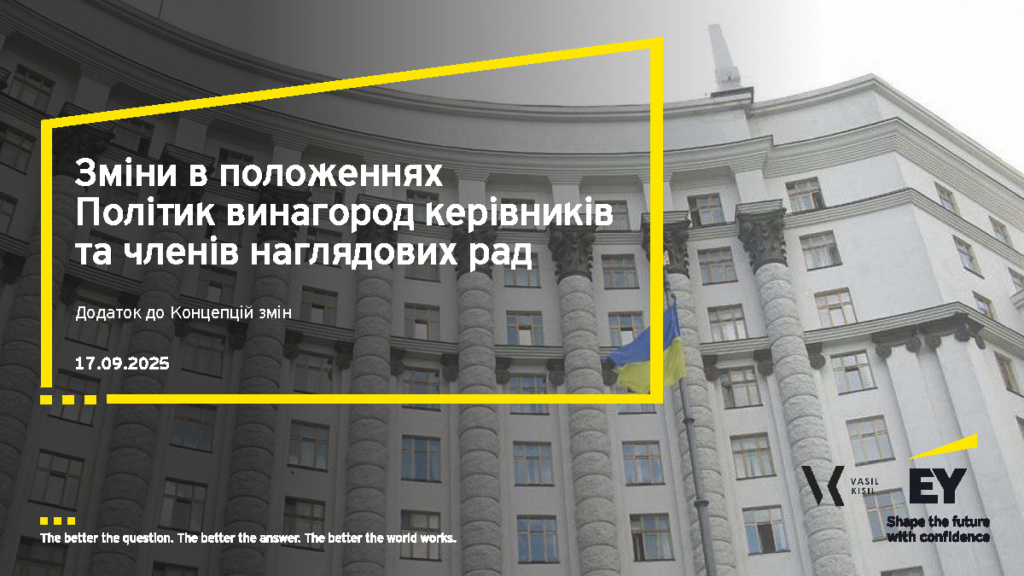
On September 19, 2025, the Corporate Governance Professional Association (CGPA), at the initiative of the Ministry of Economy, Environment, and Agriculture (MEE) and with the support of the European Bank for Reconstruction and Development* (EBRD), held a professional discussion on updating the remuneration policies for managers and members of supervisory boards of enterprises with state ownership.
The event presented the concept of key changes to the policies, prepared by a team of experts in collaboration with the Ministry of Economy, Environment, and Agriculture of Ukraine, taking into account market proposals. The presentation was followed by a discussion during which participants had the opportunity to comment and ask questions about the changes to the remuneration policies.
The speakers at the event were:
- Anna Artemenko – Deputy Minister of Economy, Environment, and Agriculture of Ukraine
- Oleksandr Okuniev – Chairman of the Board of Directors of the CGPA
- Volodymyr Igonin – Partner at Vasyl Kisil & Partners Law Firm, Member of the Board of Directors of the CGPA
- Oleksiy Yegorchenkov – Senior Manager at EY in Ukraine
- Lyubov Skoryk – Legal Advisor at the EBRD, Expert on Corporate Governance
Lyubov Skoryk confirmed the EBRD’s unwavering support for Ukraine. She recalled that even during wartime, the EBRD doubled its investments, allocating funds to both the public and private sectors, as well as to critical infrastructure. She explained that the review of state ownership and remuneration policies aims to bring them closer to best international practices and called on participants in the discussion to share their thoughts and comments actively.
Anna Artemenko reported that the Ministry, together with its partners, had collected and systematized market proposals, emphasizing the importance of public consultations before adopting any regulatory decisions. Work on changes to remuneration policies is currently underway, and the Ministry intends to proceed cautiously, taking into account both international commitments and market positions.
Volodymyr Igonin noted that the Ministry of Economy is demonstrating openness and readiness for inclusive discussion with the professional community. He emphasized the important role of the EBRD in providing systemic support for corporate governance reform in the public sector.
Oleksiy Yegorchenkov presented the rationale behind the key changes to remuneration policies. He explained that the system combines a fixed component and a variable component, which is divided into a short-term component for achieving annual targets and a long-term component for implementing strategic objectives. The proposed approach is based on KPIs: if targets are not met, remuneration is reduced, and if they are exceeded, it increases.
The high level of interest in the topic was evidenced by the registration of over 100 participants, representatives of state-owned companies, banks, law and consulting firms, international financial institutions, and academia, as well as the active participation of the audience in the discussion of remuneration issues.
Oleksandr Okuniev emphasized that even under challenging conditions, reforms in Ukraine are continuing, and the role of the CGPA in these processes is becoming increasingly important. He invited participants to the upcoming Corporate Directors Forum, where key changes of the year are planned to be discussed. He emphasized that the Association is increasingly collaborating with state bodies in the area of enhancing corporate governance.
*The event was held as part of a project implemented with the support of the Multi-Donor Account for Stabilization and Sustainable Development of Ukraine (MDA), administered by the EBRD. The MDA donor countries are Austria, Denmark, Finland, France, Germany, Italy, Japan, the Netherlands, Norway, Poland, Sweden, Switzerland, the United Kingdom, the United States, and the European Union, which is the largest donor.