



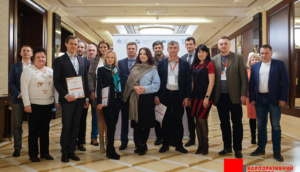
 On November 12, 2020, the XII Program of professional development of board members “Corporate Director” has come to an end. Oleksandr Okuniev, Chairman of the CGPA Management Board, discussed with the participants the issue of solving the problem of succession planning in the management of the company (succession planning), which is the task of the Board of Directors. He focused the attention on such aspects as:
- The typical examples of succession plans;
- Recommendations on the planning process;
- Manual succession plans for contingencies.
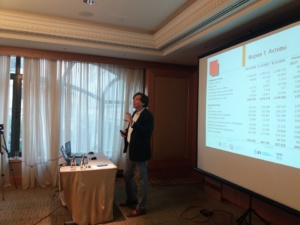 Oleksandr Pochkun, co-founder and managing partner of Baker Tilly in Ukraine, discussed the board’s role and tasks in evaluating the company’s performance with the Program participants. Separately, Oleksandr singled out the issues of the Board’s audit committee’s activity, selection, and details of work with the external auditor; shared approaches to the Board’s solution to the problem of determining the company’s top management remuneration system and the activities of the Board’s Remuneration Committee. Especially impressive were examples from Oleksandr’s own membership experience in the Boards of Ukrainian companies (including family ones) and international organizations.
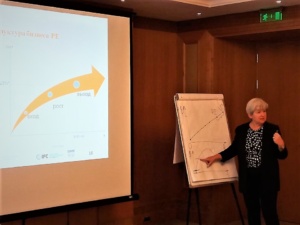 Iryna Starodubova, Associate Partner of the Capital Times, and Serhiy Goncharevych, Founder and Managing Partner of Capital Times, spoke with the Program participants about its interaction with investors, development, and implementation of the business financing strategy. The following issues were considered:
- Business financing strategy: factors, components, development, implementation
- The capital structure of the company and the cost of raising capital in practice
- Debt financing
 The attraction of capital of direct investment funds: terms of the agreement, valuation, experience
- Advantages and disadvantages of publicity: conclusions from the experience of Ukrainian companies
- Preparation of the company for the initial public offering: market choice, the sequence of actions, costs, common mistakes
- Investor relations, information policy
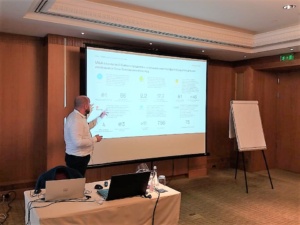
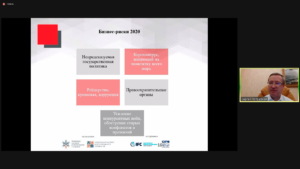 The second module of the Program ended with a presentation by Serhiy Pogrebnoy, partner of Sayenko Kharenko and Chairman of the Board of the Association of Corporate Security Professionals, to ensure its corporate security as a task of the Board. In an interactive format, S. Pogrebnoy shared with the participants the answers to the question of what is corporate security, discussed the issues of the powers of the Supervisory Board in the field of business security, and the problem of ensuring corporate business security. S.Pogrebnoy cited many examples from his practice and colleagues’ practice on successful means of ensuring corporate security and even more means of its violation and encroachment by all possible participants in the business environment.
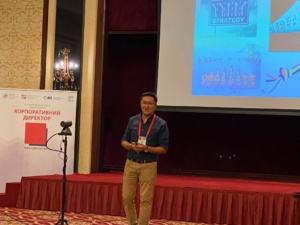 The third module of the Program was started by Timur Bairov, Chairman of the Kazakh division of Bitfury Group, Chairman of the Supervisory Board of Bridge Group, a member of the Supervisory Board of Astana Startup Hub. Timur shared his experience of board membership and strategy development of public and private companies and building companies “from scratch”. During the session, the issues of the company’s strategy and the role of the Board in its development and implementation were considered, in particular:
- Decisions about the company’s strategy and control over its implementation
- Effective procedures for preparing and adopting strategic decisions of the Board
- Risks of strategy implementation and control by the Board
- What should be the procedures for making strategic decisions?
- What information should Board members receive from management?
- And what questions should the Board ask?
 Igor Gut, Managing Partner of DYB – Develop Your Business, told the Program participants about the peculiarities of the creation and operation of advisory boards globally and in Ukraine. In particular, he focused on the following issues:
- What is an Advisory Board?
- Standard and distinctive features of the supervisory and advisory board
- How the Advisory Board works – examples of Ukrainian and foreign companies
At the end of the first day of the third module of the Program, Oleksandr Okuniev told the participants about one of the strategic tasks of the Board, namely the implementation of the anti-corruption compliance program. O. Okuniev divided the concepts of compliance, and anti-corruption compliance, answered why it is necessary to implement anti-corruption compliance procedures, which it provides, and identified and explained the main tools of anti-corruption compliance, which should be implemented primarily in companies.
The second day of the third module of the Program was devoted to considering cases that illustrate the real work of the company’s supervisory board, the peculiarities of discussions and decision-making. Igor Gut started the day by reviewing the case of choosing a company development strategy on the example of Myastoria.
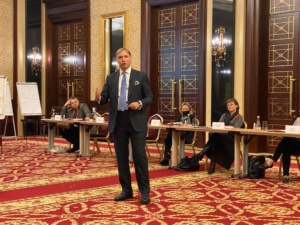 Oleksandr Onufrienko, Partner of Asters Law Firm, continued consideration of cases with Program participants. Employee relations are always a very delicate matter that requires a clear and thoughtful approach. O. Onufrienko and the participants, as members of the Board, tried to make the right decision on the choice of strategy for building relations with employees in the context of the growing conflict with the trade union. It is essential for the Supervisory Board members not to take over the company’s management role. In the chosen case, the management tried to transfer responsibility to the Board in making the right management operational decision.
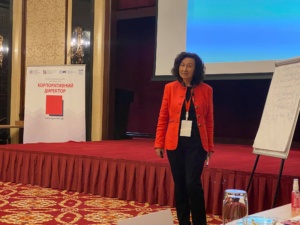 One of the tasks of the company’s supervisory board is to appoint a CEO. The first task in appointing the company’s chief executive officer is to approve the criteria for finding a candidate for this position. Anna Vlasova, Founder, and Director of the HRM School, with extensive experience in strategic personnel management, set the Program participants the task of developing criteria to start searching for candidates for the CEO position. As it turned out during the discussions, the board’s primary task, especially if the board is large, is to agree on a shared vision of the strategy (what is the CEO for? What is the organization’s purpose?)—and based on this to define criteria and requirements for candidates. Discussions of the groups were heated; the participants argued their case and made joint decisions.
In compliance with the quarantine norms and sanitary recommendations, the students and teachers were located in a huge hall at the maximum recommended distance from each other. Some students joined the classes online.
Twenty-seven participants took part in the third module of the Program: among them nine members of the Supervisory Boards, nine CEOs, three corporate secretaries; the rest were middle-managers. Ten of them represented financial institutions (banks and others). The rest were from production and service companies. One was a professor from the Odesa University.