



The Corporate GovernanceProfessional Association (CGPA) continues to discuss good corporate governance practices with all stakeholders. Last week CGPA, in cooperation with the International Finance Corporation (IFC), a member of the World Bank Group, held an online conference on “Governance for Sustainability”. The conference discussed ESG, sustainability, and the place and role of good corporate governance in the development of companies.
How does good corporate governance contribute to companies’ sustainable development, and why is the concept of “Sustainability” sometimes misunderstood? What environmental, social and corporate governance (ESG) standards are implemented by progressive Ukrainian companies? Should government regulators encourage companies to implement ESG and sustainability standards?
 The moderator of the event was Oleksandr Okuniev, Chairman of the CGPA Management Board, who emphasized the importance of ESG standards implementation in the sustainable development strategy of Ukrainian companies.
Boris Janjalia, IFC Corporate Governance Officer and expert of the IFC’s Integrated Environmental, Social and Governance (ESG) Standards Program in Europe and Central Asia, opened the event and noted that the topic of the event was very important and symbolic, as the correct and proper management of the social and environmental aspects of companies becomes the absolute foundation for sustainable development of companies today and in the future

Tatyana Sakharuk, CEO of the Global Compact Network in Ukraine, said that the UN Global Compact is a special initiative of the UN Secretary-General, which brings together responsible businesses, is, in fact, the largest in the world. UNGC encourages companies to build their operations and strategies, taking into account the Sustainable Development Goals based on ten universal principles in the field of human rights, labor, environment, and anti-corruption. In 2000 the UN system realized that the achievement of the Sustainable Development Goals was a significant priority for the United Nations. The UN system realized that it is impossible to achieve global sustainable development goals without business participation, so there was established a separate unit whose task was to involve business in addressing global issues. Tatiana also noted that companies becoming members of the UN Global Compact commit to comply with the ten principles of the UN Global Compact, work towards achieving the Sustainable Development Goals and report annually on the progress. Companies participating in the UN Global Compact are leaders in shifting the business paradigm towards sustainability. And their financial performance is growing faster than that of their competitors doing business the traditional way.
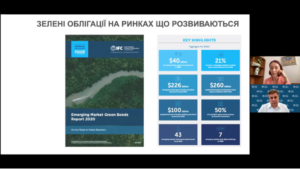
Alla Papaika, Director of Securities Issue Registration Department of the National Securities and Stock Market Commission of Ukraine, said that when it comes to sustainable development and ESG, it is primarily about financing environmental projects and information disclosure according to international standards. Financing of environmental projects is done through the issue of green bonds. Alla also noted that thanks to cooperation with IFC, the National Commission on Securities and Stock Market has already approved recommendations on the financing of environmental projects through the issuance of green bonds. Such concepts as environmental projects and green bonds have already appeared in Ukrainian legislation. These are primarily projects relating to energy efficiency, waste management and recycling, transport, agriculture, and other projects that aim to introduce specific environmental standards. In her presentation, Alla noted what international documents and principles had been considered in developing the Commission’s Recommendations: The Green Bond Principles. ICMA, EU Regulations, the EU Green Bond Standard, the International Climate Bonds Standards & Certification Scheme (ISO), national legislation (laws and regulations), the recommendations of the Sustainable Banking Network (SBN) (Sustainable banking Network, Green Bond Market Development Toolkit), SBN member states’ policy documents on green bonds.

Oleksiy Povolotskiy, Director for Corporate Governance and Compliance at DTEK, spoke about the implementation of the UN’s ESG sustainable development goals into the company’s strategy.
He pointed out that DTEK’s corporate governance system is built on the principles of informational openness and transparency. DTEK is a business that acts in the interests of Ukraine and shares the rejection of corruption at all levels. The company firmly adheres to anti-corruption standards and does not allow violations of economic sanctions regimes.
Oleksiy noted that when operating in international markets, the company understands that it can be successful only if Ukraine is successful. According to him, politicians and business should have a common goal – successful Ukraine. Honest business benefits from Ukraine without corruption. The less corruption in Ukraine, the stronger institutions, the greater Ukrainian economy, the higher the capitalization of Ukrainian companies, the more realistic a bright future for the Ukrainian economy, the stronger Ukraine will be.
Accordingly, among the main priorities of DTEK’s new strategy, which is based on principles, values and business responsibility for progress in achieving the UN’s sustainable development goals, is the determination to fight corruption. Oleksiy also added that every Ukrainian business should actively work to improve the economic attractiveness of Ukraine for investors.
In 2020, DTEK began implementing a long-term development strategy based on the UN sustainable development goals and consistent with ESG principles. It takes into account the main elements of the Green Deal and reflects the mission of business – to work for the progress and prosperity of society. The strategy also aims to bring existing internal business processes related to ESG issues in line with international best practices and standards.
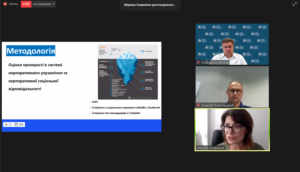
Maryna Saprykina, Chairman of the Board of the CSR Ukraine Center, presented the research conducted by CGPA in cooperation with the CSR Ukraine Center. Maryna noted that all experts say that without corporate social responsibility (CSR), there would be no ESG. CSR is about the areas which the company supports, while ESG is about measurements. And therefore, when we read the ESG strategy of the company, we will see the results which companies are aspiring to. This is what the ESG Transparency Index 2020 is about. The Index evaluates the company policy in a specific direction and the results of such policy, what indicators have been achieved. All elements of corporate governance, CSR, and reporting are assessed by indicators that are open to the public through company sites and pages in social networks.
Ms. Saprikina encouraged companies to apply for inclusion in the Index, as the screening procedure may become a test of publicity and openness to stakeholders. Link to Questionnaire
The event was held in cooperation with the IFC’s Integrated Environmental, Social and Governance (ESG) Standards Program in Europe and Central Asia, implemented jointly with the Swiss State Secretariat for Economic Affairs SECO. The goal of the Program is to encourage and assist companies in adopting best corporate governance practices, contributing to their ability to attract sustainable investments.
Link to the video