


In a typical week its quite likely you will read about organisations that have faced conflict over the direction the business is taking, or a difference in opinion on a decision between board members or perhaps even a business failing due to excessive risk taking or in some cases a lack of.
|
‘Disney ousts Marvel chair Issac Perlmutter after he clashed with CEO Bob Iger’ – FT 29 March 2023 |
‘Scottish Mortgage seeks non- executive’s exit after boardroom clash’ – FT 17 March 2023 |
The pandemic, geopolitical and economic turmoil has required that boards be more agile, requiring radical thinking about company positioning, their business models, ESG, digital transformation, inclusion and diversity, mental health and wellbeing.
There are of course those that would argue ‘if it ain’t broke – don’t fix it’ and a ‘well-oiled machine shouldn’t be tampered with’ but be wary of groupthink.
Boards with too few ‘truth tellers’ can mean that risks are not identified quickly enough, and without proper corporate governance and enough challenging opinions around the boardroom table, poor decisions can go unchecked.
Andy Fastow, former CEO of Enron when speaking at a BLC event referenced the impact of lack of diversity at Enron – he experienced a competitive testosterone-fuelled environment where fearless young men competed to be the best and thought that simply diversifying gender or age isn’t enough. He concluded that what was required was genuine diversity of thought and perspective.
Which leads us to ask – do boards have the right mix of board members around the table to help them steer the business through choppy waters and identify opportunities early?
The UK Corporate Governance Code states that board appointments should “promote diversity of gender, social and ethnic backgrounds, cognitive and personal strengths.” Over the last decade we’ve seen initiatives such as the FTSE Women Leaders and Parker Reviews increase gender and ethnic representation on boards, and less visible diversity traits such as social economic diversity, especially in the boardroom, are an increasing area of focus.
There is increasing evidence that bringing insights from people with a range of experiences and knowledge enhances creativity, promotes innovation and reduces groupthink – but boards have been slow to disclose how they ensure cognitive diversity around the boardroom table, and how they factor it in to board appointments and succession planning.
Perhaps the benefits of diversity have been somewhat ‘mis-sold’ with the presumption that hiring people from historically excluded groups will automatically result in increased performance. But for these efforts to be truly effective and ‘bear fruit’ – board diversity will require a different approach and skillset. It not only requires the recruitment of diverse board members that bring different skills and perspectives but also requires leadership that can leverage that diversity and bring out the richness of the board as a whole.
Earlier this year we engaged the University of Leeds to conduct a literature review on cognitive diversity over the last decade to establish how boards might benefit from considering the balance of thinking styles across their board members.
As expected, the definition of cognitive diversity varied greatly across publications and there are inconsistencies in how it is measured including the metrics and indicators used to track it which make it difficult to make comparisons.
“Boards are being asked to drive change in a lot of social and cultural issues that are not part of the traditional board mandate. We’re not hired or voted in by society and yet, we are being asked to help drive those changes. It is a very challenging situation that companies find themselves in, even with the best intentions”. Dr Dambisa Moyo speaking at a BLC event
However, four themes around how cognitive diversity could benefit organisations within broader IDE strategies emerged:
- Boards should ensure that they create an inclusive culture that allows diversity of thought to thrive in pursuit of better decision making and oversight.
- Progress on diversity of the full of protected characteristics needs to benefit from the consideration of cognitive diversity. Cognitive diversity should be considered as connected to but not displace, other IDE initiatives.
- Leadership training should include interventions to allow diverse opinions to be expressed and valued, breaking down long-established traditions. It should not be assumed that the benefits of cognitive diversity can be achieved simply through the recruitment and promotion of individuals of different backgrounds and experiences.
- The intersectional experience of board members might be a progressive means through which cognitive diversity can be achieved. Recognising people’s intersecting experiences could provide a different approach to solve problems
How do you know if you have a good mix of board members to maximise effectiveness whilst not creating unrest or dysfunctionality?
We asked 165 audit committee members to categorise their own style of thinking in the hope of identifying those elements of diversity that are likely to be absent around the audit committee table –and by extension, around the board room table.
In some respects, the findings show that audit committee members already exhibit diversity of thinking styles with respondents showing a roughly equal propensity for being idea initiators and idea generators; diplomatic and forthright; and task-orientated and people-orientated.
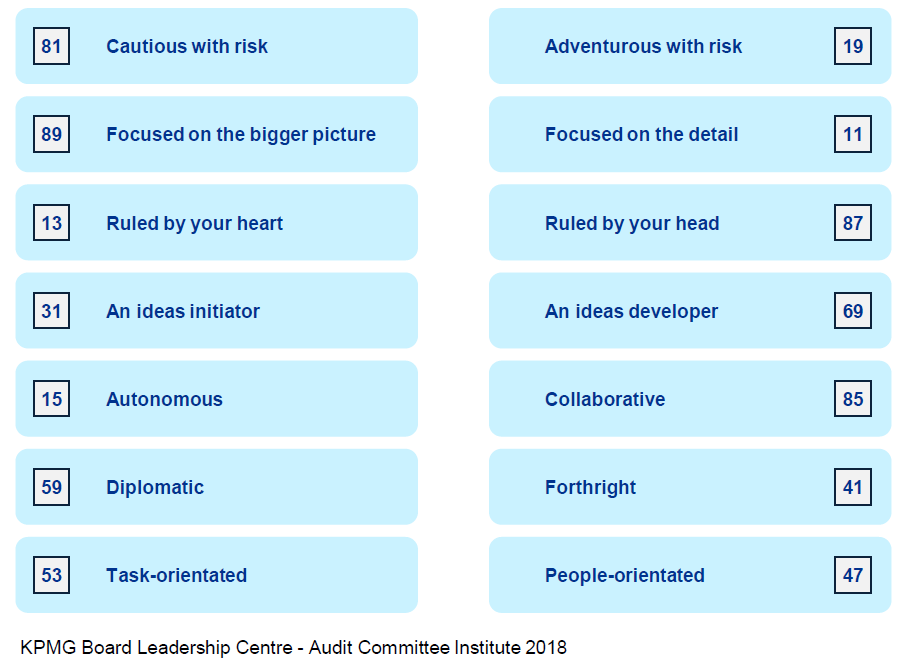
The results also show us that audit committees may benefit from more people who are ‘risk adventurous’ rather than those who are ‘risk cautious. Excessive risk aversion could lead to a lack of innovation and ultimately stagnation and failure. To quote Mark Zuckerberg “the biggest risk is not taking any risk. In a world that’s changing quickly, the only strategy that is guaranteed to fail is not taking risks.”
Might we also conclude that UK boards (or at least audit committees) are very light on autonomous, risk adventurous, detail thinkers who are ruled by their hearts?
Perhaps, perhaps not. But to create diverse boards more work needs to be done to identify the way board members think and operate; and whether there is the right balance on any one board.
“Ultimately, representation is important —but it isn’t enough to make meaningful progress alone. To get the most out of a diverse board, it’s critical not just to recruit a few women or people of colour, but to take an intersectional approach to diversity, challenge assumptions around status and experience, and invest in building a culture of true inclusion.”Randall S. Peterson & Heidi K. Gardner –Harvard Business Review
Taking cognitive diversity into consideration
Recruitment criteria -Identify what skills are ‘really’ essential to the role –if the recruitment criteria are too rigid you might limit cognitive diversity and attract less candidates.
Different professional experiences are an asset -Our ‘Poised for change?’ survey showed that one impediment to recruiting diverse candidates was that the board was inclined to recruit from a narrow social/business circle. It is worth reviewing where candidates gained their professional experience –those that have experience of ’different walks of life’ may have a different approach to problem solving.
What type of thinkers do you need around the boardroom table?
- Risk cautious vs risk adventurous?
- Idea initiators vs idea generators?
- Diplomatic vs forthright?
- Task oriented vs people oriented.
- Detailed thinking vs strategic thinking/seeing thebigger picture?
- Collaborative vs autonomous?
- Logical vs emotional?
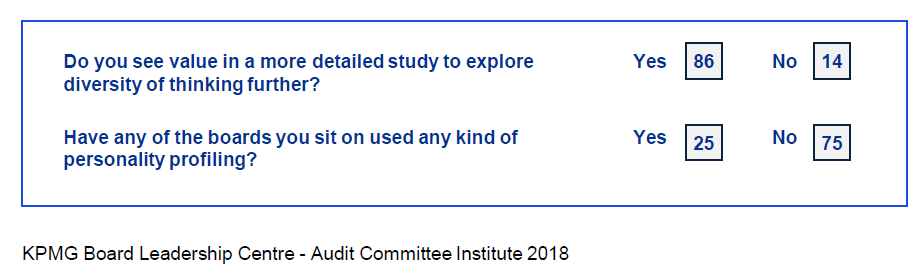
Consider personality profiling -Two thirds of our survey respondents said that no personality profiling was done on their boards. There are many assessment tools that can help to form a picture of the blend of personalities around the boardroom and, maybe more importantly, identify those that are missing.
The role of executive search firms -executive search firms should be briefed on both the skills sets and types of critical thinking required when recruiting for candidates.
Strong Chairs -Chairs need to create an inclusive environment in the boardroom to ensure board members feel safe to express their views, challenge group think and ask the questions that matter.
Checking in –regular one-to-one ‘temperature’ checks with board members will enable the Chair to assess whether everyone feels comfortable in contributing.
Conclusion
Developing and maintaining a high-performing board that adds value requires a proactive approach to board building and diversity –of skills, experience, thinking, gender, ethnicity and social background.
Whilst cognitive diversity is often regarded as an expected outcome of inclusion and diversity practices, it should be considered as a key component of board composition and succession planning. It is a new area but likely to grow in importance as the board agenda becomes more varied in a challenging economic and socio-economic environment –86% of those responding to our survey felt that diversityof thinking requires further exploration.
While determining the company’s current and future needs is the starting point for board composition, examining cognitive diversity amongst current board members can help highlight a lack of thinking style or identify skills sets required of new board members. Awareness of the cognitive diversity of board members might well encourage boards to approach issues in ways that might ordinarily be overlooked.
The ability of the Chair to leverage from cognitive diversity around the boardroom and create an inclusive environment where all perspectives are nurtured and heard will be critical.
Джерело: https://assets.kpmg.com/content/dam/kpmg/uk/pdf/2023/05/critical-thinking.pdf